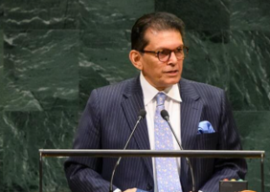
By Dikeledi Molobela
New York, USA — United Nations General Assembly President Khalilur Rahman has called for urgent action to rebuild trust in the multilateral system, saying the credibility of the world body depends on its ability to deliver results, undertake meaningful reform and respond to the challenges facing people around the world.
Addressing the opening of the general debate of the
81st session of the General Assembly in New York on Tuesday, Rahman said the United Nations had endured for eight decades because of its unique role as a forum where countries can pursue diplomacy and collective solutions.“The United Nations has persevered. Not because it is perfect, but because it is irreplaceable,” he said.
However, Rahman said endurance alone is no longer enough, as people are increasingly questioning whether the organisation is delivering on its mandate.
“Outside these walls, people are not asking whether the United Nations still exists. They are asking whether it works,” he said.
The 81st session is being held under the theme “Restoring trust, managing transformation: a United Nations that delivers for all.” The General Assembly brings together all 193 UN Member States, with each represented on an equal footing.
Rahman said rebuilding confidence in the UN will require realism, reform and greater inclusion.
“Trust is not given. It is earned,” he said.
He pointed to conflicts in Gaza, Sudan, Ukraine, Myanmar and elsewhere as evidence of the challenges facing the multilateral system, stressing that international law, civilian protection and humanitarian access cannot be applied selectively.
African representation matters
Rahman called for the UN Security Council to take stronger action when peace is threatened and said the body must become more representative and transparent, reflecting contemporary geopolitical realities.
He placed particular emphasis on Africa's continued underrepresentation on the Security Council.
“Africa needs to be at the table, not on the menu,” Rahman said, describing greater African representation as a matter of fairness, justice and the credibility of the United Nations.
The call comes as reform of the Security Council remains a key issue in debates on making the UN system more representative of the contemporary international order.
Reform and value for money
Rahman also called for greater accountability in the way the United Nations uses its resources, urging Member States to meet their financial obligations.
“We want to have full value for money,” he said, while calling on countries to pay their dues on time and without conditions.
“We must also recognise that dues to the United Nations come from hardworking people around the world,” he added.
Rahman said Member States need to take greater ownership of the organisation and its reform process.
“If we do not claim proactive ownership of this place, we cannot expect it to heal,” he said.
The UN General Assembly President has made restoring trust and delivering concrete results central to his presidency.
In his opening statement earlier this month, he said restoring trust required both delivery and reform, with the organisation needing to demonstrate that it effectively serves the people in whose name it acts.
AI brings new global risks
Turning to artificial intelligence, Rahman warned that the rapid development and widespread integration of the technology presented challenges that cannot be addressed by governments alone.
“We cannot also rule out the possibility that AI, particularly artificial general intelligence, or AGI, could affect human survival,” he said.
He noted that governments no longer hold a monopoly over expertise, capital, technology, innovation or influence, while highlighting the extent to which AI has already become embedded in everyday systems.
Unlike earlier technological and proliferation challenges, Rahman said, AI is already present across areas including water systems, electricity grids, health records, economies and militaries.
“We cannot allow an arms race for control of AI to carry us over the precipice,” Rahman said.
His remarks come as the UN places greater emphasis on international cooperation and governance around emerging technologies during the 81st session.
The UN's high-level week is addressing interconnected challenges, including peace and security, sustainable development, climate change and technological transformation.
Rahman said the UN's ability to respond to these challenges will ultimately depend on Member States' willingness to reform the institution and work collectively.
The general debate runs from 22 - 28 September at the UN headquarters in New York.
SA participation at UNGA81
South Africa is participating in the 81st session of the UN General Assembly, with International Relations and Cooperation Minister Ronald Lamola leading the South African delegation during high-level week.
As part of South Africa’s programme, Lamola, Deputy Minister of Health Joe Phaahla and South Africa’s Permanent Representative to the United Nations, Ambassador Mxolisi Nkosi, are participating in a number of high-level engagements at the UN headquarters.
These include a high-level side event on the implementation of the Pact for the Future in Africa, hosted by Namibia, Zambia, the United Nations Economic Commission for Africa (UNECA), the African Union, the Executive Office of the UN Secretary-General and the Office of the Special Adviser on Africa.
The engagement, which takes place in Conference Room 2, focuses on advancing implementation of the Pact for the Future in the African context.
Later, Lamola, Phaahla and Nkosi will participate in the Global Leaders’ Network (GLN) on Women’s, Children’s and Adolescents’ Health, taking place in Conference Room 4.
South Africa is a co-founder of the Global Leaders’ Network and is hosting the engagement together with Spain, Denmark and Tanzania.
The engagements form part of South Africa’s broader participation in UNGA81, where the country is advancing its priorities on strengthening multilateralism, reforming global governance and addressing development challenges affecting Africa and the Global South. – SAnews.gov.za

No comments:
Post a Comment