By Dikeledi Molobela
New York, USA — South Africa has called for stronger protection of financing for women, children and adolescents’ health, warning that shrinking development assistance, rising debt burdens and limited fiscal space are threatening hard-won gains in global health.
International Relations and Cooperation Minister
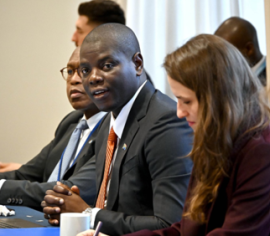
Ronald Lamola made the call on Tuesday while representing President Cyril Ramaphosa, Chair of the Global Leaders Network (GLN), at a high-level GLN event on financing for women, children and adolescents’ health during a time of austerity at the 81st United Nations General Assembly in New York.The event, co-hosted by South Africa, Spain, Tanzania and the Partnership for Maternal, Newborn and Child Health, brought together political leaders, health ministers, global health leaders and strategic partners to discuss practical, country-led approaches to sustaining investment in the health of women, children and adolescents.
Lamola said the GLN, a network of 12 sitting Heads of State and Government, has, since its launch in 2023 worked to keep the health of women, children and adolescents’ high on the political agenda, while helping countries translate commitments into action and protect health financing.
“We recognise that maternal, child and adolescent mortality cannot be reduced without sustained investment.
“We also recognise that universal health coverage and economic development cannot be achieved without protecting the resources for women, children and adolescents’ health,” Lamola said.
Financing under pressure
Lamola said the global health financing environment has become increasingly difficult, with official development assistance falling by just over 23% in 2025.
He said the decline has placed additional pressure on procurement systems and health workforces in low- and middle-income countries, undermining efforts to ensure equitable access to essential maternal and child health commodities.
“Rising debt burdens and shrinking fiscal space make it harder for countries to adjust to the sudden cuts in official development assistance,” he said.
Lamola pointed to the scale of the wider financing challenge, noting that more than 3.3 billion people now live in countries that spend more on interest payments than on schools and hospitals, with more than 750 million of them in Africa.
Against this backdrop, he said the GLN has pursued an action-oriented agenda focused on closing financing gaps, protecting existing gains and keeping health-related Sustainable Development Goals accelerators alive.
This includes a six-part webinar series on domestic resource mobilisation, which brought together more than 900 participants from over 40 countries, including Ministries of Health and Finance, development finance institutions, the private sector, academia and civil society.
The discussions, he said, demonstrate that countries are willing to explore new approaches to health financing.
“We were blown away by the innovations so many of our members had already implemented,” Lamola said.
The GLN also identified underutilised opportunities, including debt-for-health swaps, while highlighting the importance of knowledge exchange between countries.
From dialogue to action
Lamola said the GLN has subsequently moved from dialogue to implementation through its Financial Diplomacy Series, which brings Ministries of Health and Finance together with investors and technical partners to develop financing plans for country health programmes.
In just five months, four GLN members - Liberia, Kenya, Sierra Leone and South Africa - have developed business cases.
Lamola said representatives from the four countries met investors and partners in New York on Monday to further develop those cases into financing plans.
“This clearly shows the political commitment to support countries to mobilise resources for women, children and adolescents,” he said.
He also highlighted the Public-Private Partnership Health Accelerator, an initiative developed by South Africa and Botswana to help close financing gaps by bringing together the private sector, diaspora, philanthropies, Southern and global foundations and development partners.
The initiative was recognised as an official G20 legacy project during South Africa’s G20 Presidency.
Lamola said the initiative demonstrates the potential for partnerships to mobilise additional resources for health in low- and middle-income countries.
Looking ahead, Lamola said the GLN's message is both simple and urgent: countries must protect the resources needed to sustain essential health services.
“We cannot protect the health and rights of women, children and adolescents unless we protect the financing that sustains essential services and sexual and reproductive health and rights,” he said.
He called on governments to protect and increase allocations to women’s, children’s and adolescent health and to track expenditure against outcomes.
“Governments must protect and grow funds allocated to women, children and adolescent health and track spending against outcomes,” he said.
He also urged development partners to align their financing and technical assistance with national plans.
“Together, we can protect essential services, use every available resource more effectively and ensure that women, children and adolescents remain at the centre of health financing decisions.”
Austerity is not an excuse
World Health Organisation Director-General, Dr Tedros Adhanom Ghebreyesus, told the gathering that global progress in maternal and child health needs to be protected, noting that maternal mortality has fallen by 40% over the past 25 years, while child mortality has more than halved.
However, he warned that progress has slowed and that preventable deaths continue to occur at an unacceptable scale.
“We meet in a time of austerity, but austerity is not an excuse. It's a test. A policy without a budget is a press release. A commitment without financing is a promise already broken,” Ghebreyesus said.
He called on leaders to protect health spending during periods of fiscal pressure, saying women, children and adolescents should not be first to bear the consequences of funding cuts.
He also called for financing for sexual and reproductive health services, particularly in humanitarian settings, and urged governments and partners to demonstrate progress through measurable results.
“The measure of our leadership will not be what we pledged in New York. It will be whether the woman in labour tonight sees the morning,” he said.
Turning political commitment into investment
United Nations Population Fund (UNFPA) Executive Director, Dr Diene Keita, also highlighted the continuing financing gap affecting women's health, saying millions of women and girls are being affected as official development assistance contracts.
She said investment in women and girls generates broad social and economic returns, and welcomed countries that are taking greater ownership of their health agendas.
Keita highlighted efforts to strengthen investment in frontline health workers, including midwives, and called for greater financing for contraception and maternal health services.
The GLN event formed part of South Africa's high-level programme during UNGA81, as the country continues to advance multilateral cooperation and country-led approaches to development and global health financing. – SAnews.gov.za

No comments:
Post a Comment