While South Africa has the scientific expertise to develop innovative pharmaceutical products, it needs stronger capabilities to take promising discoveries from the laboratory into clinical testing, manufacturing and ultimately into the hands of patients.
This was the message emerging
CSIR Group Executive for Advanced Chemistry and Life Sciences, Dr Rachel Chikwamba, said South Africa remains heavily dependent on imported active pharmaceutical ingredients (APIs), with about 98% of the APIs used to make medicines locally imported.
This, she said, leaves the country’s pharmaceutical manufacturing sector vulnerable to external shocks, inflation in input costs and fluctuations in foreign exchange. She added that South Africa has strong capabilities in early stage research, but these capabilities weaken when innovations need to be translated into products that can be scaled safely and efficiently.
“The vision of Future Pharma is to close the gap. How can we ignite a thriving, inclusive local pharmaceutical manufacturing industry?” Chikwamba said.
The first phase of FuturePHARMA focused on building the translational capability needed to take research through product development and into clinical testing, while laying the foundation for increased local pharmaceutical manufacturing.
A second phase will focus on scaling these capabilities and developing strategic capacity to strengthen the healthcare system, meet day-to-day needs and improve preparedness for future pandemics.
Building the bridge from science to patients
Chikwamba said the facility will bring together the infrastructure, skills and expertise needed to support process development, product development, analytics, quality systems and regulatory development.
This will allow promising concepts and prototypes emerging from South Africa’s innovation ecosystem to progress towards clinical testing and, ultimately, full-scale manufacturing.
Chikwamba said the CSIR has drawn on lessons from more than two decades of investment in research and manufacturing infrastructure, including its experience in biomanufacturing.
The CSIR’s Biomanufacturing Industry Development Centre has demonstrated how infrastructure can be used to train a skilled workforce, while supporting the development of products, and services and growing the biotechnology industry.
The CSIR has subsequently been recognised by the Africa Centres for Disease Control and Prevention as a regional manufacturing capability and capacity development hub, while the World Health Organisation has designated it as an African biomanufacturing training hub.
The facility will have two major capability areas. The first is a small-molecule product and process development facility, focusing on medicines, such as painkillers and anti-inflammatory drugs, through conventional batch chemistry, flow chemistry and biocatalysis, supported by digital capabilities.
The second is a biopharmaceutical product and process development capability, which will focus on protein-based medicines and other biopharmaceuticals, including vaccines, pharmaceuticals and factors produced using plant systems, yeast expression systems and mammalian cell culture.
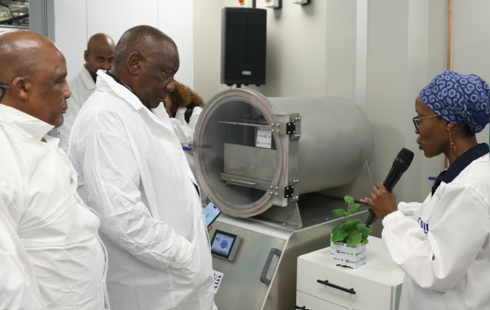
Today's launch programme included demonstrations of some of these capabilities, including small-molecule pilot products, giving guests an opportunity to see the infrastructure and technologies being developed at the facility.
Open-access platform for researchers and industry
Chikwamba said FuturePHARMA was designed as an open-access national capability rather than a facility intended solely for the CSIR.
“It is to ignite the system by availing these capabilities to our researchers in the universities, in other research councils and industry itself, so that they can take their products from just concepts into the clinic and beyond,” she said.
The facility is intended to support entrepreneurs and emerging businesses by providing access to infrastructure, technical expertise, regulatory support, skilled personnel and manufacturing capabilities without requiring them to make significant investments in their own facilities at the earliest stages of development.
Entrepreneurs will be able to test their ideas, establish whether products are viable, develop technology packages and produce initial runs for market testing.
They will also be connected to businesses, funders and other industry players.
Chikwamba said this model can help to create a pipeline of new pharmaceutical businesses, while developing the skilled workforce required by the growing African pharmaceutical manufacturing sector.
SAHPRA commits to enabling local production
For the South African Health Products Regulatory Authority (SAHPRA), FuturePHARMA represents an opportunity to strengthen the regulatory and manufacturing ecosystem supporting local production.
SAHPRA CEO Dr Boitumelo Semete-Makokotlela said local manufacturing is not simply an industrial objective but directly linked to access to medicines and health security.
“The COVID-19 pandemic ... reminded us that countries and regions with limited manufacturing capacity can become vulnerable when global supply chains are disrupted,” she said.
SAHPRA has adopted a policy position aimed at enabling local manufacturing, while maintaining the required standards for quality, safety and therapeutic efficacy.
Under a policy published in 2025, SAHPRA supports locally manufactured health products through shorter evaluation timeframes and reduced assessment fees, while maintaining rigorous regulatory standards.
Semete-Makokotlela said the regulator intends to work closely with the CSIR, as FuturePHARMA develops the regulatory authorisation required for its operations.
“We were able to demonstrate this as we supported the mRNA [messenger ribonucleic acid] vaccine manufacturing platform. We are here today to communicate our intention to the CSIR that we will partner with you, we will support you, and there will be a moment where we will wear the hat of [the] police (sic),” Semete-Makokotlela said.
She said enabling local production cannot be achieved by the regulator alone and requires alignment between science, industry, financing, procurement, trade, health policy and regulation.
This is particularly important against the backdrop of medicine shortages in South Africa, with patients sometimes unable to access medicines because of disruptions to global supply chains.
SAHPRA is already working with the CSIR and other national regulatory authorities on the continent through the regional biomanufacturing hub hosted by the CSIR.
Semete-Makokotlela said the partnership will also extend to training regulators in small-molecule manufacturing, building on existing collaboration in biological products.
WHO backs stronger African manufacturing capacity
The World Health Organisation (WHO) representative to South Africa, Dr Shenaaz El-Halabi, said FuturePHARMA can help to address a longstanding challenge of translating scientific discoveries into medicines that are available, safe, effective and affordable.
She said the facility also supports Africa’s broader ambition to take greater responsibility for its health security.
“For a patient waiting for treatment, scientific progress means a medicine that is available when needed, safe and effective and affordable.”
El-Halabi said dependence on external supplies can leave countries vulnerable when global production is disrupted or international demand increases sharply, as experienced during the COVID-19 pandemic.
She highlighted the importance of partnerships between government, research institutions, industry, regulators, health services and international organisations in building sustainable local production.
The WHO framework for strengthening local production of medicines, vaccines and other health technologies in the African Region for 2025 - 2035, calls for a holistic approach that includes research and development, innovation hubs, technology transfer and partnerships.
Under this approach, governments can align industrial development with public health priorities, research institutions can contribute discoveries and skills, industry can bring manufacturing expertise, while regulators ensure the quality and safety of products.
El-Halabi also highlighted the CSIR’s growing role in developing Africa’s biomanufacturing workforce.
“Sandbox” for preparedness
Looking ahead, Chikwamba described FuturePHARMA as a “sandbox”, a controlled environment where the country can test not only its ability to develop and manufacture safe products, but also the logistics, supply chains and technical systems needed to respond to health emergencies.
The facility will maintain active capabilities by producing products required by the innovation ecosystem and continually training its workforce.
This, she said, will ensure that the country does not only build infrastructure during a crisis, but maintains a ready capability before the next emergency occurs.
She said a maintained capability will allow the country to identify a threat, activate the necessary response, and mobilise the platform more rapidly.
“Our response rate will be faster. We will not be waiting in line ... to get products from other [countries],” Chikwamba said. – SAnews.gov.za

No comments:
Post a Comment